
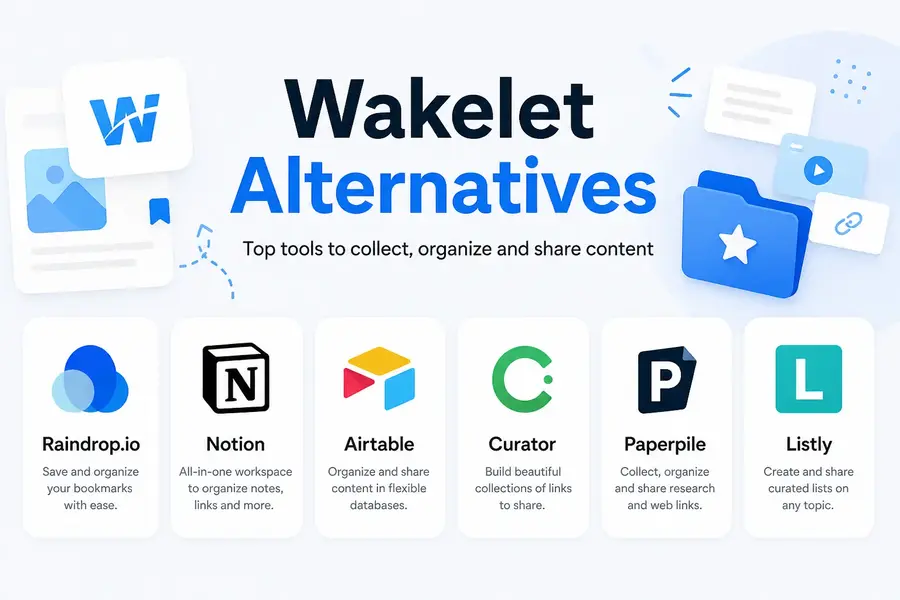
Curation of content has become significant in the way individuals learn, teach and communicate online. Although Wakelet has been a popular resource collection and sharing tool, a lot of users are in the market searching to find the alternatives to Wakelet that will provide them with alternative features, better customization, or collaboration. Being a student, teacher or even content developer, the proper platform can streamline your workflow and ensure that it becomes more efficient.
This paper will have a closer look at some of these powerful alternatives, why people are thinking of switching and how you can make the best decision depending on your needs.
Why do people seek out Wakelet Alternatives?
Wakelet is easy to use and simple, but it might not be suitable in all applications. This is because some users desire advanced features, whereas other users have preferred layouts or integrations. Among the most frequent causes why people have to look to find alternatives, better organization tools can be mentioned, in particular, when dealing with sizable bodies of content.
Customization is another determinant. Certain platforms provide the ability to have more control over the look and feel of collections, which can be important in branding or presentation. Another big issue is the collaboration especially when it comes to teams or classrooms where more than one person is required to make contributions at a time.
It can also have performance and platform constraints. Other apps may be required to help with your workflow, offline features, or offer a better search and tagging system.
Wakelet Alternatives to try
The selection of the tools that can be successfully used to replace them is high, but each has strengths. The selection of the correct one will depend on your intended use.
Pocket (app) is one of them. It is best suited to store articles, videos and web pages that can be read later. Its intuitive design and lack of connectivity has made it a popular among those who prefer an intimate reading tower, over a communal collection device.
Padlet is another good option. Education is one area particularly popular in use of this platform due to the ability to have an interactive board where many individuals may post their material. It accepts photos, links, video and documents and so is very versatile.
Professionals and marketers would find scoop.it to be a great option. It is owned by curated content and publication where users compile curated topics and share with an audience. It also involves analytics that can be handy with tracking engagement.
To the more visual mindset of the people, Pinterest can work as a useful substitute. Although it commonly is used when referring to content about lifestyle, it is best when it comes to arranging ideas and inspiration, as well as resources in a visually stimulating fashion.
Finally, Milanote provides a scalable canvas-like design. It works well with creative work, brainstorming and sorting out ideas that are complex through notes, images and links.
Major Characteristics to consider in a Curation Tool
Not every tool is created equal, so you should draw attention to the aspects that are the most important to your workflow. Having a content curation platform that allows easy saving and organizing of resources without introducing additional complexity is important.
It should also have search and tagging capabilities. As more items are stored in your collection, it becomes important to be able to locate particular items in a short period of time. Sites that provide sophisticated filtering or tagging based on keywords can save much time.
Another vital characteristic is cooperation. When dealing with a group or running a classroom, you must have something that can support multiple contributors and, at the same time, be structured and understandable.
Customization can also be an option. Certain tools provide an opportunity to customize layouts, colors, and themes and make your collections more interesting and professional. It is particularly necessary, when you want to present your work in the open.
The other benefit is the integration with other apps. These tools link to much-needed browsers, cloud storage, or productivity applications and can streamline your workflow in order to make fewer platform changes.
Best Wakelet Substitutes as a Teacher
Teachers frequently require tools that are accessible, students cooperate, and they are applicable to all ages. In this respect, the simplicity and accessibility play a crucial role.
Padlet is unique in the fact that it enables an instructor to create interactive boards on which the pupils can provide their ideas, links and assignments. It promotes interaction and enhances learning in lessons.
Project-based learning is also beneficial with the use of Milanote. Its graphics allow students to arrange thoughts and work together on creative assignments. It is especially effective in the cases that involve brainstorming or planning.
The other alternative is to use Google tools such as Google Keep or Google Sites. Although not specific curation tools, they can be modified to facilitate organizing and sharing in a classroom.
The primary objective of teachers is to select an aid that can help to improve the learning process without introducing misunderstanding. An efficient interface and user-friendly design can go a long way towards student interaction with the platform.
Most suitable platforms to creators and marketers of content
More complex features are frequently required by content creators and marketers particularly with regard to the publishing and audience engagement. Scoop.it and other tools such as that are a more professional means of content curation in this instance.
These sites enable users to create thematic collections, post them via social media, and even monitor performance. This is why they are perfect in regard to personal branding or business.
Here, Pinterest is also very influential particularly in visual materials. It assists creators to arrange ideas and forward traffic to their websites or blogs. It can also discover new audiences on curated content using its discovery algorithm.
Pocket, in turn, is more personal research appropriate. It assists creators to store and access precious materials, which are subsequently applicable in writing, planning, or inspiration.
The decision to use a particular tool is based on whether you are working internally or externally sharing. There are even those users who use a combination of several tools to have the best of both worlds.
The problem of the selection of the right alternative
The idea of choosing the most appropriate is not to choose the most popular tool but rather to comprehend what you need. The first thing to do is to determine your main aim. Do you compile resources on yourself, in a class, or on a portfolio?
Then, take into account the way you want to structure information. There are those who might enjoy an organized list, and those who might enjoy a visual board or a customizable layout. The interface must be familiar to your habitation of thought.
Scalability should also be brought into consideration. An appropriate tool in the beginning can prove to be very challenging as your collection expands. Search around to find platforms that will be able to support bigger volumes without making it sluggish.
Lastly, never commit before trying some options. The tools are generally free, so it becomes a matter of trial and error in order to find whatever feels comfortable. The brief experiment can enable you to prevent frustration in the long-term.
Final Thought
Discovering the best wakelet alternatives may be a great way to upgrade your organization and sharing process. As great a solution as Wakelet is, other options can be used. Each of the tools discussed above possesses its own strong points: Pocket, Padlet, Scoop.it, Pinterest and Milanote can serve various user needs.
The most effective way to do this is to look at your workflow and select a platform which fits it. Be it an appreciation of simplicity, working together, or powerful capabilities there is a tool to help you achieve your objectives and content curation be more efficient.
FAQs
What are the best free wakelet alternatives?
Some of the best free options include Pocket, Padlet (with limitations), and Pinterest. These tools offer strong basic features without requiring a paid subscription.
Which alternative is best for students?
Padlet and Milanote are great for students because they are easy to use and support collaboration, making them ideal for group projects and assignments.
Can I use multiple tools instead of one?
Yes, many users combine tools. For example, you might use Pocket for saving content and another platform for sharing or presenting it.
Are wakelet alternatives better than Wakelet?
Not necessarily better, but different. Each tool has its own strengths, so the best choice depends on your specific needs.
Do these tools support team collaboration?
Yes, many alternatives like Padlet and Milanote allow multiple users to work together in real time, making them suitable for teams and classrooms.
